


How Sanctions Improved My Art


We all know that Russia has been impacted by worldwide sanctions.
I for one- SUPPORT those sanctions. Why should a country keep profiting from global trade if they're committing brutal war and acts of violence against innocent people? They shouldn't.
That being said, sanctions have made it much harder for me to learn and interact with my heritage, and it's made it impossible to purchase items that are made from local peoples. I take these challenges not as a downside, but as an opportunity to experiment.
I have spent my entire life playing around with art, learning different techniques, and growing my own style into what it is today and whenever a new project lands into my lap, I get excited, not daunted. From what I've learned through my online research (cross-translating hundreds of pages and using VPNs to access information abroad), and genetic testing on yours truly, I've come to learn that I am native to the region I am from. While I don't know many specific details about my immediate birth family yet, I am a mix of Udmurt, Volga Tatar, and Mordovian- basically I am a Finno-Ugric/Tatar from the local Volga-Ural region. My family and bloodline have lived there for hundreds if not thousands of years- but here I am in the Pacific Northwest, oceans away from my native rivers, mountains, and meadows.
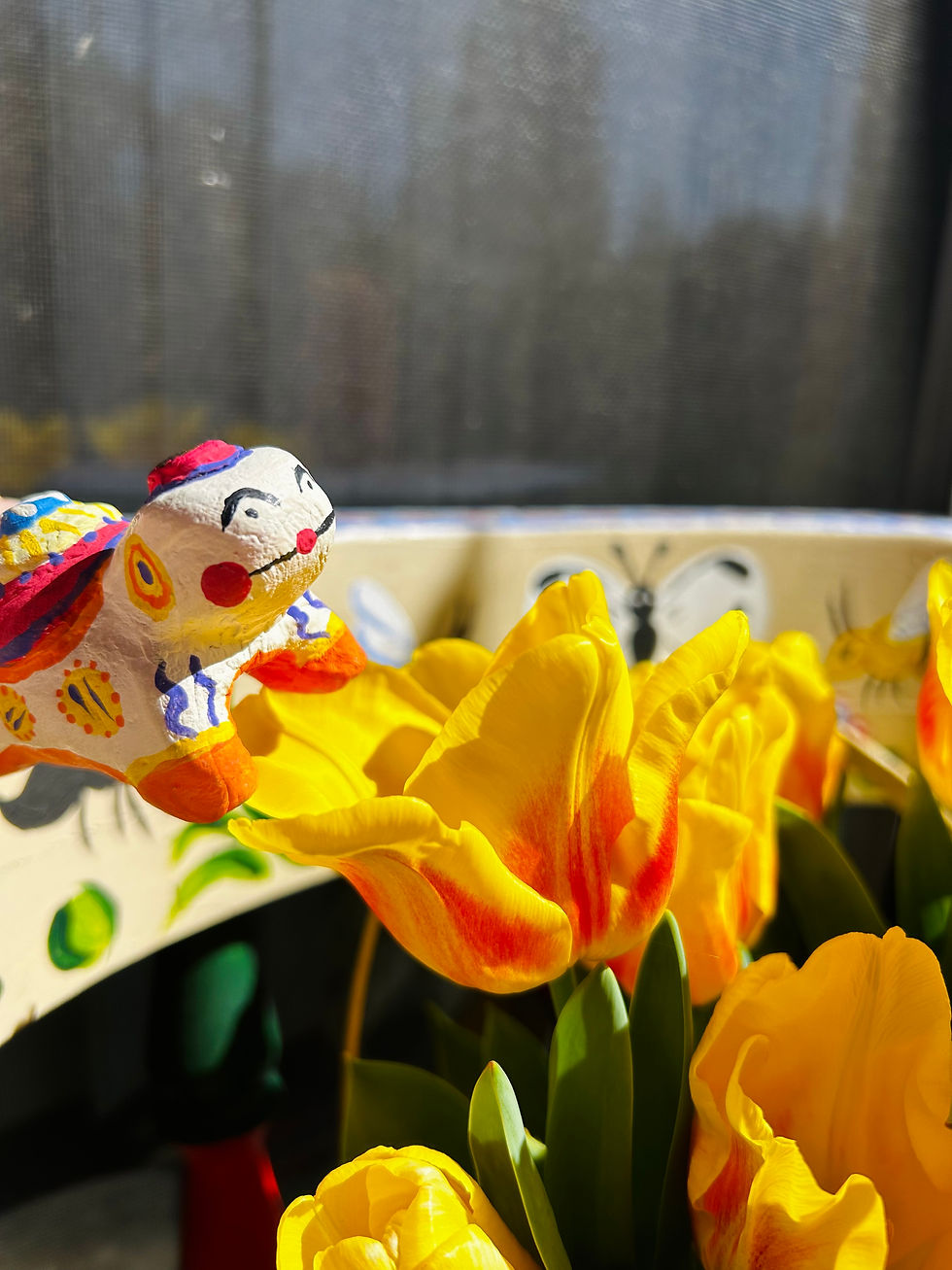
My interest in dabbling in folkart arose a few years ago after I began doing more medieval and renaissance styles in my paintings. I've always loved connecting with heritage and growing a stronger sense of identity and I realized that I could channel some of my favorite artists like Ivan Bilibin, in my own style. This then led me to researching arts within Kirov Oblast where I was born, and I started the Dymkovo Diaries project where I make Dymkovo figures and place them in an animated colorful world.

My mind started to feel a little frustrated. How do I channel both being an artist and being a Volga-Ural native without carrying around a painting or sculpture? The answer: Fiber arts. Traditional costume and embroidery vary from every ethnic culture in so many beautiful ways and I realized I could create things that #1 I cannot buy, and #2 channel my roots through wearables.

My first finished project was a Volga Tatar embroidered apron dress using traditional chain-stitch. While it's not entirely authentic in structure, I have worn it several times and always get compliments and a chance to tell others what it means! Crafting a more traditional Tatar apron will come at a later date.

The next project on my mind is to make an entire (basic) Udmurt traditional outfit. Udmurt dress is very layered usually with a red tartan dress as the base layer, with a different tartan/striped/plain apron on top that features colorful embroidery and lace trim, patterned socks, black booties, headscarves or headwraps, and most excitingly- Монисто or beaded coin bib necklaces. I already ordered the underdress, a cheap score from a Kansas seller on eBay, but I'm on the hunt for a good layering tartan that I can embroider motifs within the squares and I'm collecting pennies from my own findings and the contributions from family and friends. After all, our horrible president said "no more" to pennies, so why not combine my ethnic background and American life together by making a monisto with Abraham Lincoln currency! I'm very excited for that, but I plan on taking my time putting together this outfit by embroidering the motifs on the apron, making a crochet lace trim by hand, and crafting the monisto after cleaning and punching holes in all of the pennies. It's going to be quite the big project.
What began as a big question mark for how to connect with my Volga-Ural background with Russian sanctions in place became a quest I'm still on to implement new creative projects into my life. It is evident that my ancestors were artistic, and not only do I carry their features in my face and body, but in my motivation to design beautiful folkart pieces and clothing. Layers of barriers might stand strong between me and my homeland but I'm grateful and excited to practice my language skills and crafting skills as I learn more and evoke my background through my work.
A good challenge teaches more lessons than staying the easy path ever could.
~Anastasia Sergeevna Razumova


Comments