


Being A Pro-Ukrainian "Russian"


In our current day there are many conversations revolving around the question, “is this cultural appreciation or appropriation?” As I’ve been looking more into my heritage as well as learning more about my partner’s Ukrainian heritage, that question becomes ever more central in my mind when it comes to russia.
I was born in Kirov Oblast, russia, by the Cheptsa river where my ancestors have lived for hundreds to thousands of years. Through my extensive genealogical and genetic research, I have learned that I’m an ethnic mix of local tribes known more modernly as the Cheptsa Tatar or Nokrat Tatar, Udmurt, and Besermyan groups. These cultures are full of rich history, traditions, art forms, cuisines, and languages among other things that have been russified (aka colonized/changed by russian overlords) to a point that many people with my heritage reject it or have been forcibly removed from it physically through deportation or legally on their papers. This is also what occurred in Ukraine during the Soviet Union and what threatens them still every day during the war.
When people think of russia, some of the most common images associated with the nation are onion domed- cathedrals and matryoshka dolls. Perhaps maybe delicious borscht. But all of these things have been stolen from other places. Now, one could argue that some of these things have been assimilated into pan-russian culture by this point, but I’d argue that since russia has tried to put their stamp on those things as their own, they are still stolen icons.
Matryoshka dolls originated in Japan and were originally inspired by traditional Chinese boxes. Onion domes originated in central and Western Asia. Borsch originated in Ukraine and is still Ukraine’s national dish. In my region, Arabic was spoken and written alongside native tongues way before russian language was introduced. Paganism and Islam were practiced before Orthodox Christianity was enforced. But these things, places, and people that reside within russia’s greedily growing borders are continuously lumped into being of russian origin due to russia’s unethical dominion over others.
There have been regional movements to regain independence over territory within russia’s borders, but none have been granted their autonomy in recent years. This includes the growing independence movement in Tatarstan, a republic just south of Kirov, which is one location where Volga Tatar culture is most preserved and appreciated. But those attempts have been unsuccessful. In fact, there have been extra efforts by russia to silence and subdue different populations within their borders to assimilate to whatever russia's identity tries to convey. This includes arresting people who speak and write in their ethnic languages, arresting people peacefully practicing religions that russia deems as “promoting anti-russian ideals”, and arresting people that make political art or speak up in support of Ukraine or plainly acknowledge that a war is being waged.
But what is russian culture really? Polluting our sacred rivers with toxic runoff from building weapons? Impoverishing their citizens to the point where the only solace they have is drinking alcohol? Acquiring more land that will eventually fall to decay and ruin as infrastructure is ignored and the younger generations move out? Slav squats, vodka shots, or boasting about shooting up your former comrades? Are those things to be prideful of?
I have always had a difficult relationship with being an international adoptee from russia. It’s hard feeling so far removed from one’s own people and culture, but I also feel blessed to not have been clouded by a shield of misinformation or forced to grow up on the gopnik filled streets. It’s become so much more difficult to uncover the truth versus propaganda while trying to embrace my background. In order to uncover any information of use I have to use VPNs, translators, and cross references. Americans view russia as what the russian government portrays and while that is partially correct, the hundreds of ethnicities and cultures within its borders are ignored or unknown to the point that Americans don’t even know about the multitude of famines, genocides, and wars that russia has incited against what they claim is “their own people.”
Since the full-scale invasion started in 2022, I have been feeling the weight of the atrocities russia is committing, while getting more disappointed by America’s lackluster support. It feels like every day russia is being allowed to commit heinous violence that the American public either ignores or doesn’t want to see. I have never faltered in my advocacy and outspoken allegiance with Ukraine but sometimes it feels like I’m screaming into a vacuum that no one other than my partner and our circle of international allies seem to hear. I’m frustrated and exhausted by how little effort both russians and Americans are putting in to support Ukraine. I’m exhausted worrying for our friends in Ukraine fighting on front lines or just trying to live their lives. This war has taken an indescribable toll. It’s heartbreaking and unnecessary. Bombing children’s hospitals, maternity wards, and apartments? It’s cruelty in its basest form.
These burdens haven't stopped me and my partner though; it’s just provided us with more challenges to overcome. My partner runs the 501(c)(3) organization, The Sunflower Coalition, which I eagerly volunteer for, helping manage the website, social media, and physically putting together shipments and coordinating with our international colleagues. He has worked tirelessly to raise awareness, money, and supplies for Ukraine and has visited multiple times during wartime to help, including staying in the Donbas region which has been heavily bombed and occupied. I am in awe of his dedication and passion to what he does, and I have always been committed to his cause. Currently we even have a stack of boxes my height full of medical supplies to get shipped out. Helping Ukraine is something on our minds 24/7. We both feel strongly that Ukraine cannot fall physically or ideologically into russia's hands.
Internally I sometimes feel complicated with my identity. There’s a guilt I try to ignore due to being from a region within russia. The guilt I feel isn’t that of “what have I done?” It’s more so a dreadful pain of “why are my people participating in this war, how do they feel okay doing this, and what can I do to be the opposite of what russia wants me to be?”
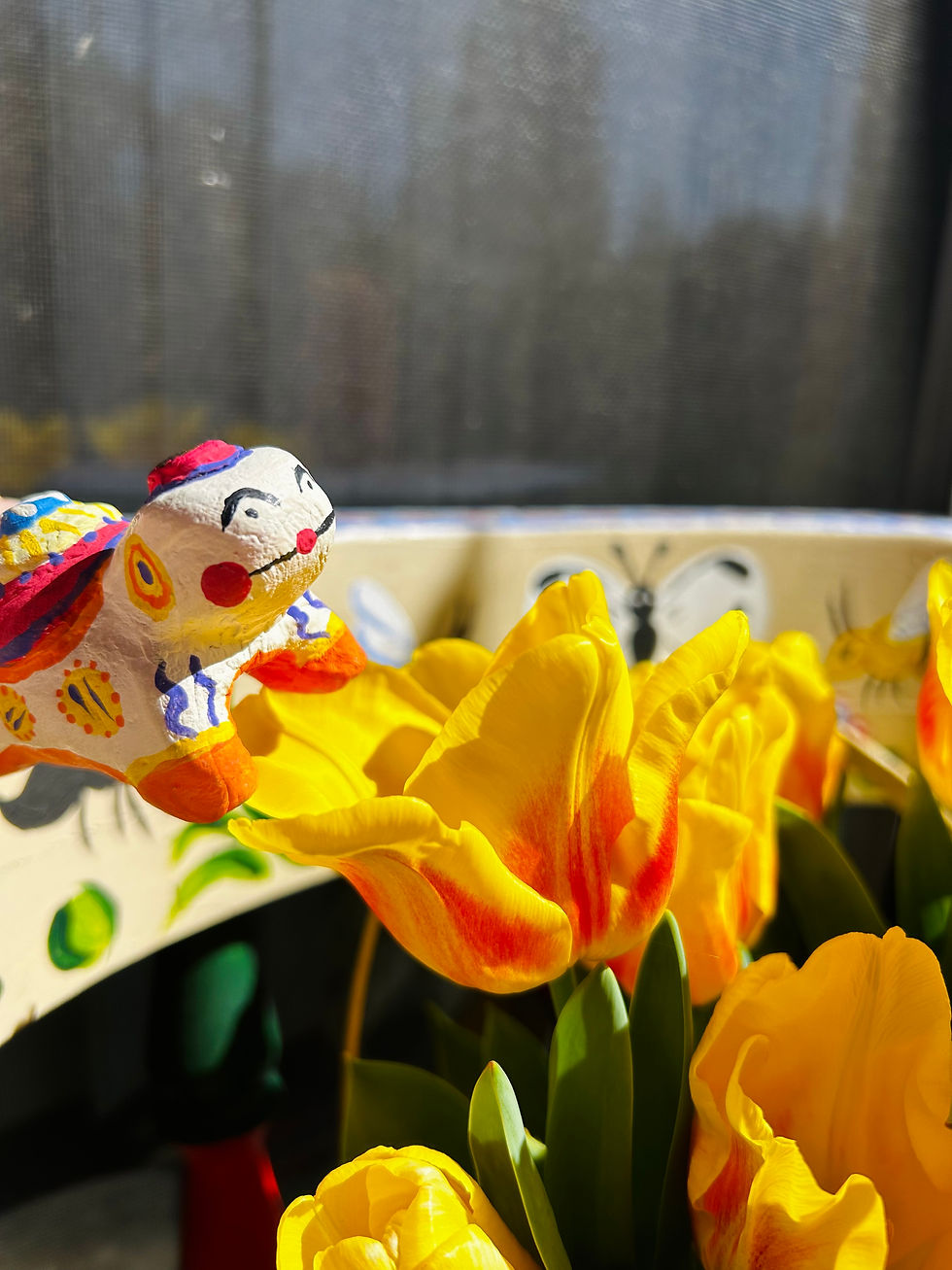
I still allow myself to connect with and embrace my heritage that I wish I could have experienced in my homeland or earlier in my lifetime. I make art and food from my culture. I listen to music and dress in clothing and regalia that my people would also wear. I’ve even gone so far as to create Dymkovo figures from the Kirov region and animate them in my short video series called DymkovoDiaries on social media. But in my heart and home I mainly highlight and appreciate Ukraine, for my multicultural family and for our values. We have Ukrainian flags everywhere, art pieces, artifacts- I cook Ukrainian food, we listen to music, speak some phrases to eachother, and we wear Vyshyvanka. I would never Russify Ukraine. I embrace and love Ukraine as it is. And I celebrate it as much as or even more than I celebrate my own heritage.
Sometimes the guilt arises. Sometimes the confusion, hatred, and shock in response to russias war crimes surfaces through my tears or outbursts of anger. But at the end of the day, I am a Cheptsa Tatar in love with a Ukrainian, and I actually do the work to support Ukraine and preserve my own culture and my partner's culture no matter how hard it gets or wearisome it can be to witness a war four years in. And that is what I’ll continue to do no matter how long it takes. No matter what has to happen. Ukraine should be free and Cheptsa should be free.


Comments